Real clients. Shipped outcomes.
Selected case studies across all three Revuity Systems service lines: Forward Deployed Engineering, Collab, and Fractional CIO.
New client revenue, generated within the first three weeks of rollout.
An agentic compliance platform built and deployed from zero against a $700M+ federal aid portfolio in Los Angeles.
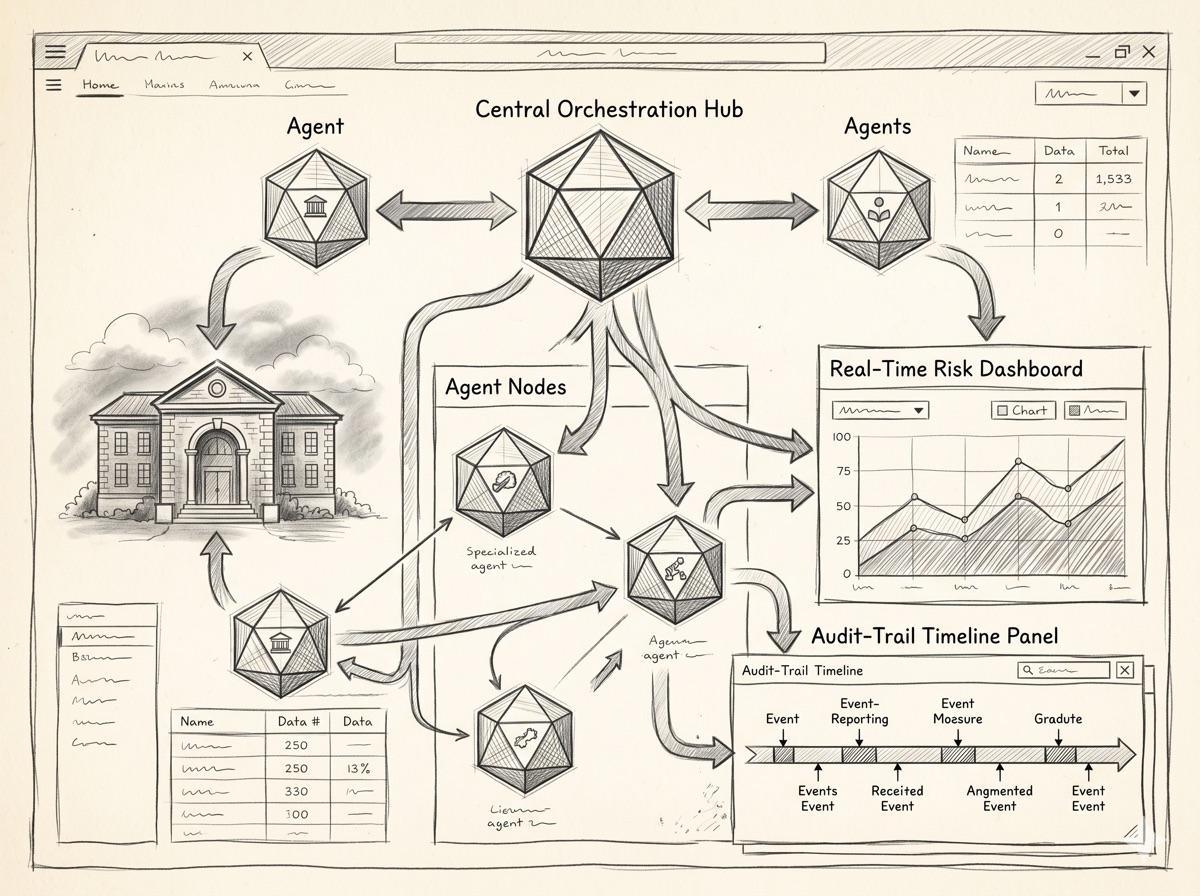
Financial Aid Compliance System
Higher education. Title IV federal financial aid
Production since 2024
Built and deployed one of the first production agentic AI systems in regulated higher education, automating compliance workflows across a $700M+ federal aid portfolio with $2.7M in revenue generated.
A higher education institution needed to govern Title IV regulatory decisions across a $700M+ federal aid portfolio without a corresponding increase in compliance headcount. Manual processing was error-prone, audit-intensive, and fundamentally unscalable. Previous automation attempts had failed because the compliance logic was too complex for rule-based systems and too regulated for black-box AI. The VP of Compliance needed a production-grade system with full audit trails, not a proof of concept.
We designed and deployed the system from the ground up: a multi-agent orchestration platform that automates regulatory decision workflows end-to-end, surfaces risk in real time, and produces audit-ready output at every step. The system routes decisions through specialized sub-agents, maintains a complete audit trail, and escalates edge cases to human reviewers with full context pre-loaded. We also developed BurgessEval, a proprietary LLM evaluation framework for measuring compliance accuracy in regulated environments, and designed a System Inventory and User Management Registry for the compliance team.
- $2.7M revenue generated across cost reduction, error elimination, and process velocity.
- End-to-end automation of Title IV compliance workflows across a $700M+ aid portfolio.
- One of the first production agentic AI deployments in regulated higher education.
- Full audit trail at every decision point, diligence-ready output from day one.
Multi-Agent Support Copilot
B2B SaaS. 200+ employees
6 weeks
Cut tier-1 support ticket volume in half with a retrieval-augmented agent wired into the customer's existing ticketing stack.
The support team was drowning in repetitive account, billing, and how-to tickets. Previous attempts to bolt on a chatbot had produced confident-but-wrong answers, eroded trust with customers, and required the team to babysit the bot instead of reducing load. Leadership wanted agentic automation, but only if it came with measurable accuracy guardrails and a clean escalation path to humans.
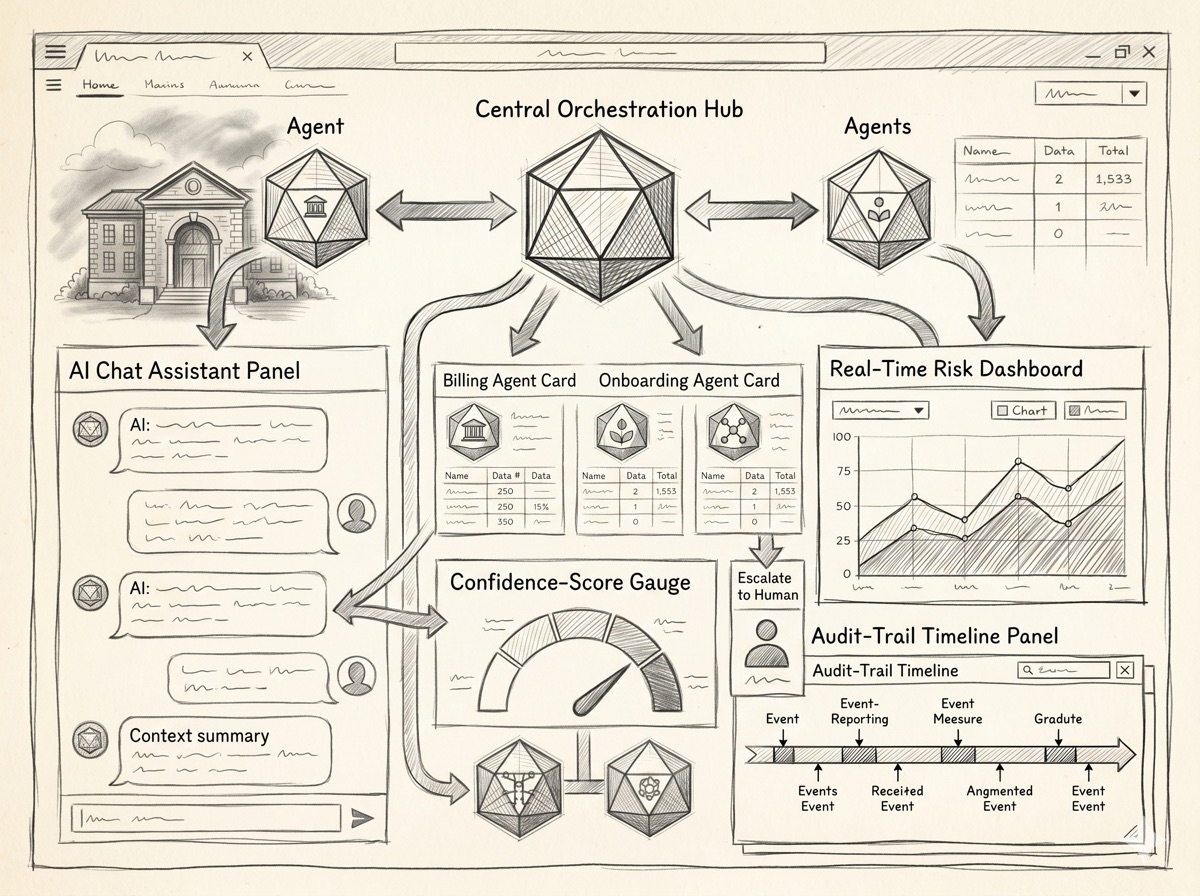
We ran a two-week strategy sprint to map the top 20 ticket intents, then deployed a RAG pipeline grounded in the client's help center and internal runbooks. A router classifies intent and hands off to specialized sub-agents (billing, onboarding, integrations). Every answer ships with a confidence score; anything below threshold is escalated to a human with full context pre-loaded. We built an eval harness so the team can regression-test the agent every time the knowledge base changes.
- 52% reduction in tier-1 ticket volume within the first 60 days.
- First-response time dropped from 4h 20m to under 90 seconds.
- 94% answer accuracy measured against a 500-ticket eval set.
- Zero hallucinated policy answers since launch (grounded retrieval only).
Legacy ERP Modernization
Regional manufacturer, $85M revenue
11 weeks
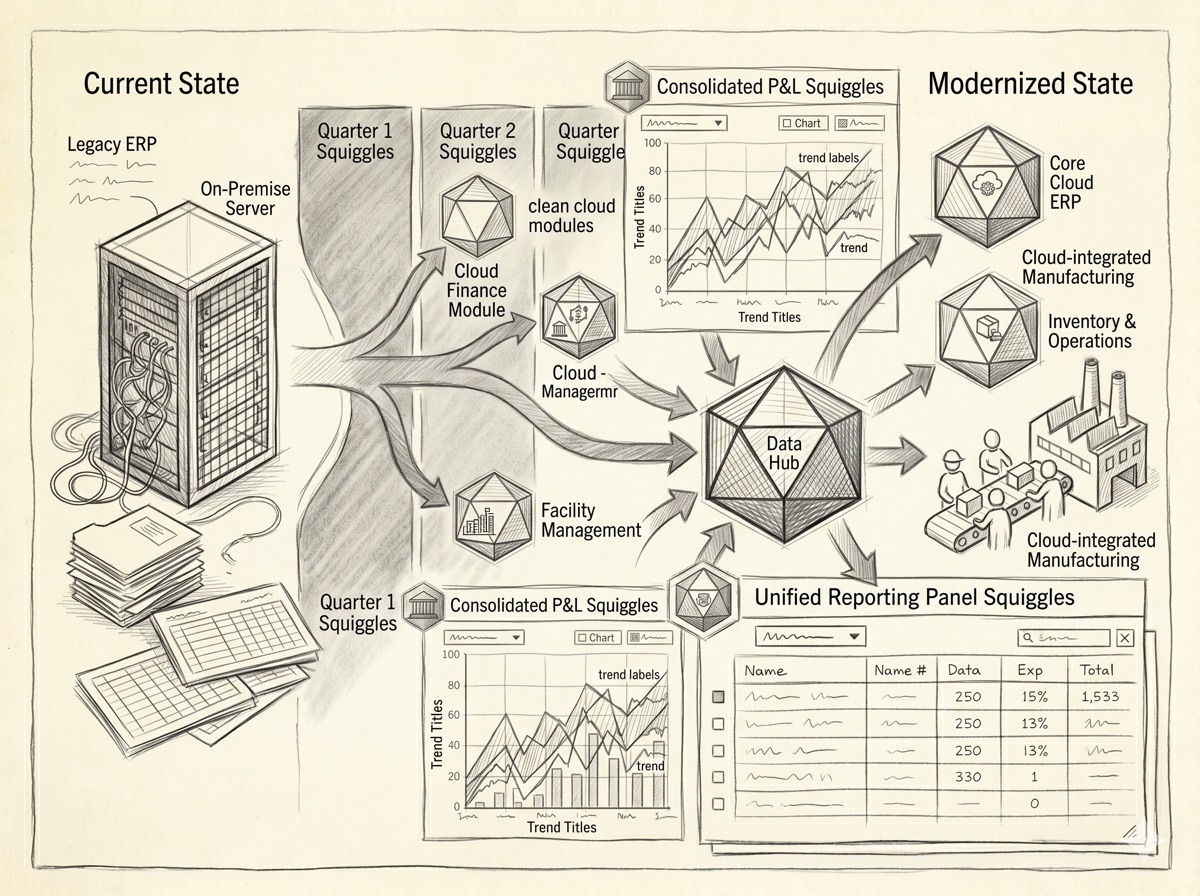
Turned a fragile on-prem ERP and a wall of Excel macros into a phased cloud roadmap, without a forklift upgrade or a six-figure consulting retainer.
A 40-year-old manufacturer ran its shop floor, order management, and AR on a heavily customized on-prem ERP that only two retiring engineers knew how to maintain. Previous modernization pitches from big-name consultancies came in at $1.2M+ and an 18-month timeline. Leadership needed a credible, staged plan they could actually fund out of operating cash flow.
We ran a 2-week assessment covering the tech stack, the team's skill ceiling, and the customer-facing systems most exposed to failure. Then we built a 6-quarter roadmap: de-risk first (daily off-prem backups + a warm standby), then replace the weakest modules (order entry, AR) with cloud-native equivalents, then modernize the core. No big-bang cutover. Each quarter ships a shippable win, funded as a discrete engagement. We also trained an internal team so the client could own the journey after Q2.
- Replaced order entry and AR in the first 11 weeks. 100% of orders flowing through the new system.
- Eliminated the single-person-dependency on legacy ERP maintenance.
- Total program budget 68% below the original big-consultancy bid.
- Internal ops team now leading the Q3 and Q4 phases without outside help.
Business Command
Agency operations
Shipped in 4 weeks
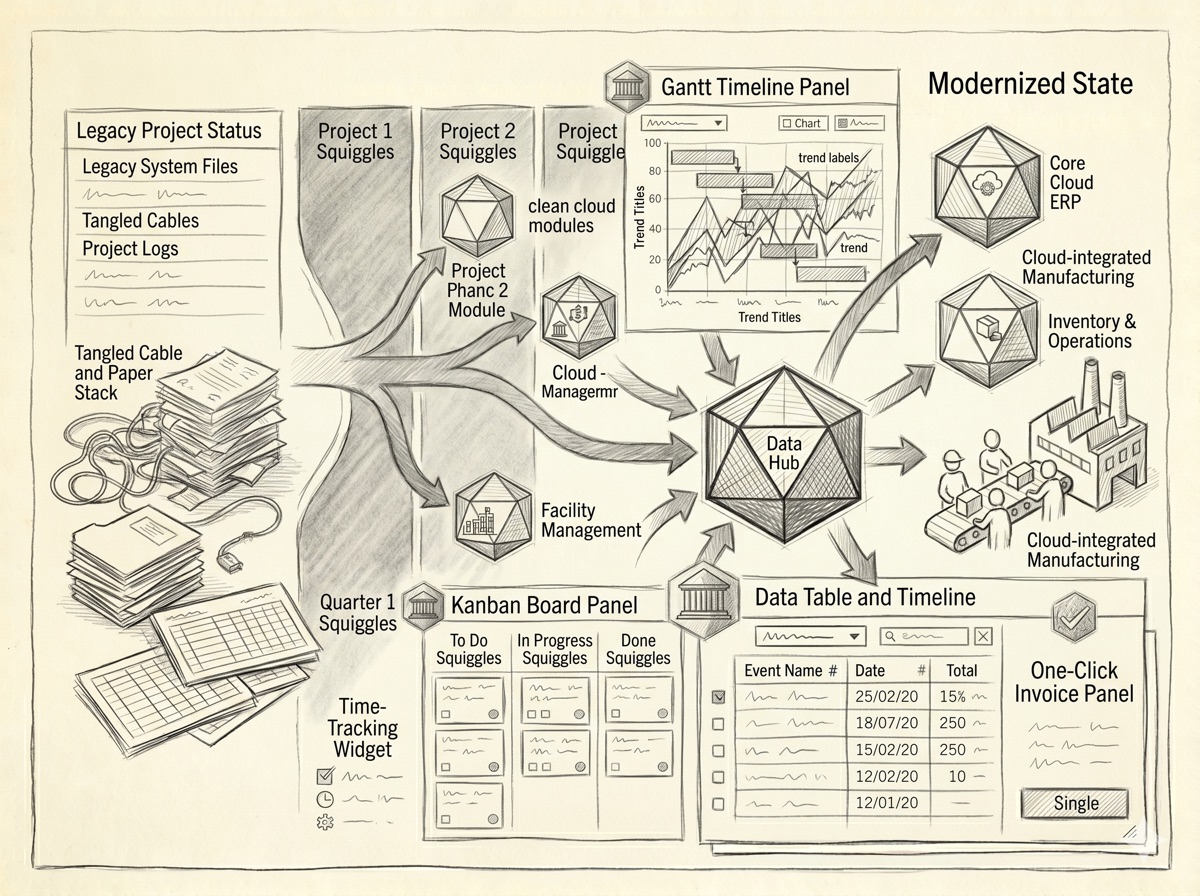
A clarity-first project management SaaS. Kanban, Gantt, time tracking, and billing in one lightning-fast SPA, designed to replace the agency tool stack, not add to it.
The founder had spent two years using a patchwork of Asana, Harvest, and Excel to run a service business. Every tool owned a slice of the workflow; none owned the whole picture. Clients were invoiced late, utilization reports took half a day, and the team hated the context-switching. The founder wanted a single product that made profitability visible in real time without intimidating the creatives who had to use it daily.
We ran a 1-week product sprint to lock scope to the three workflows that actually moved revenue: task tracking, time-to-invoice, and utilization reporting. Architecture used React with a real-time Postgres-backed schema, shipped as a single-page app so every view felt instantaneous. The billing module syncs with tracked time automatically, turning timesheets into invoices with one click. We built it as a standalone SaaS the founder now operates independently.
- Replaced 3 legacy tools (Asana, Harvest, Excel) for the pilot agency.
- 40% reduction in project scoping time.
- Live in production and actively managing agency retainers.
- Shipped end-to-end in 4 weeks from kickoff to first paying customer.
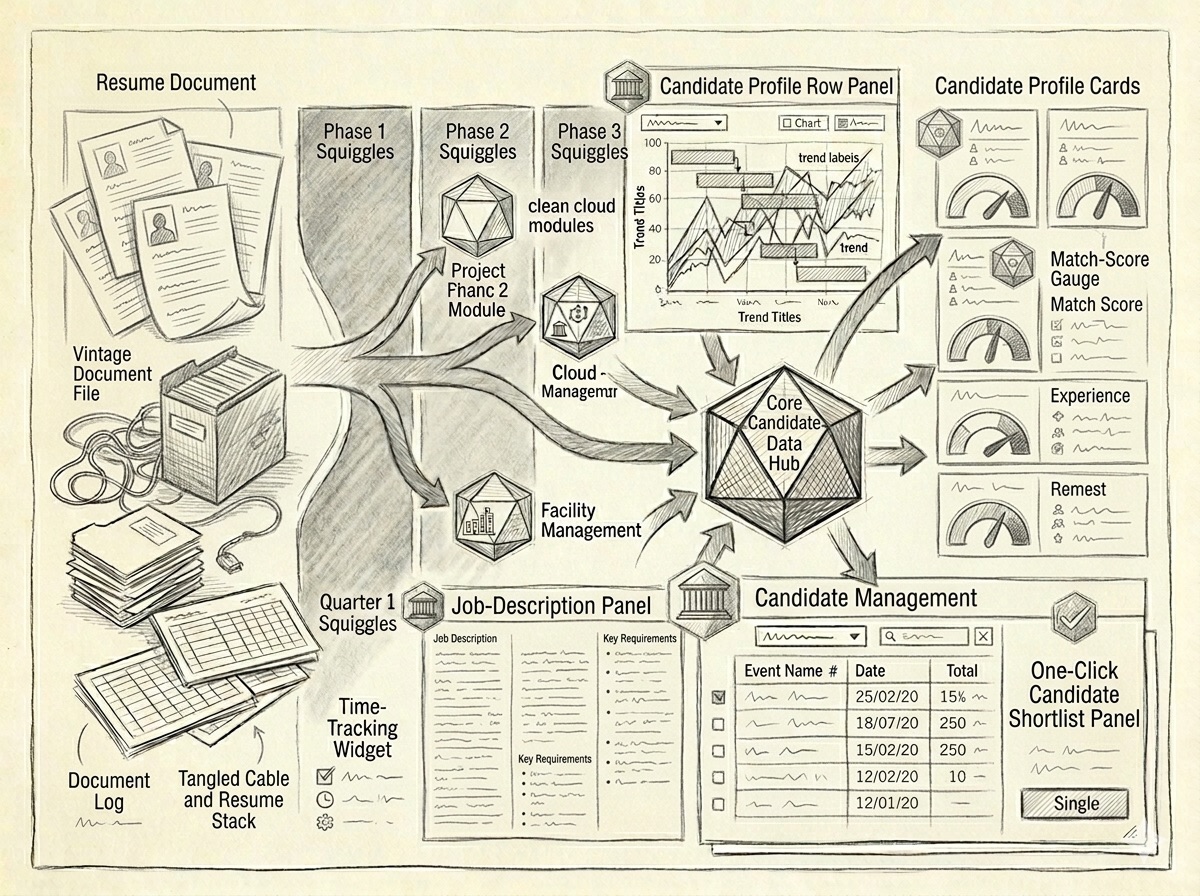
ProHired for a Staffing Operator
Regional staffing firm
Licensed + branded in 3 weeks
A regional staffing firm licensed ProHired as their own branded candidate-matching platform, going to market with an AI product in weeks, not quarters.
A 40-person staffing firm was losing deals to VC-funded competitors that marketed AI-powered matching. Building something equivalent in-house was a 12-month, $500k+ project they couldn't justify. They needed an AI-native candidate platform on their domain, in their brand, and in their pricing model, fast enough to pitch at a trade show eight weeks out.
We licensed ProHired, our AI-powered resume and job-discovery platform, under a private-label agreement. Their team got a branded instance with custom domain, logo, palette, and email templates in under three weeks. We migrated their existing candidate database, configured their industry-specific scoring weights, and trained their account managers on the admin console. They own the customer relationship, their data, and their pricing. We handle the core platform and ongoing updates.
- On stage at the trade show with a branded AI product 3 weeks after signing.
- Closed 14 new accounts in the first quarter post-launch.
- Zero engineering headcount required, operated by their existing ops team.
- License cost came in at 4% of the estimated in-house build.
ServiceFlowAI for a Home-Services Rollup
Home-services holding company
Licensed + deployed across 4 brands in 6 weeks
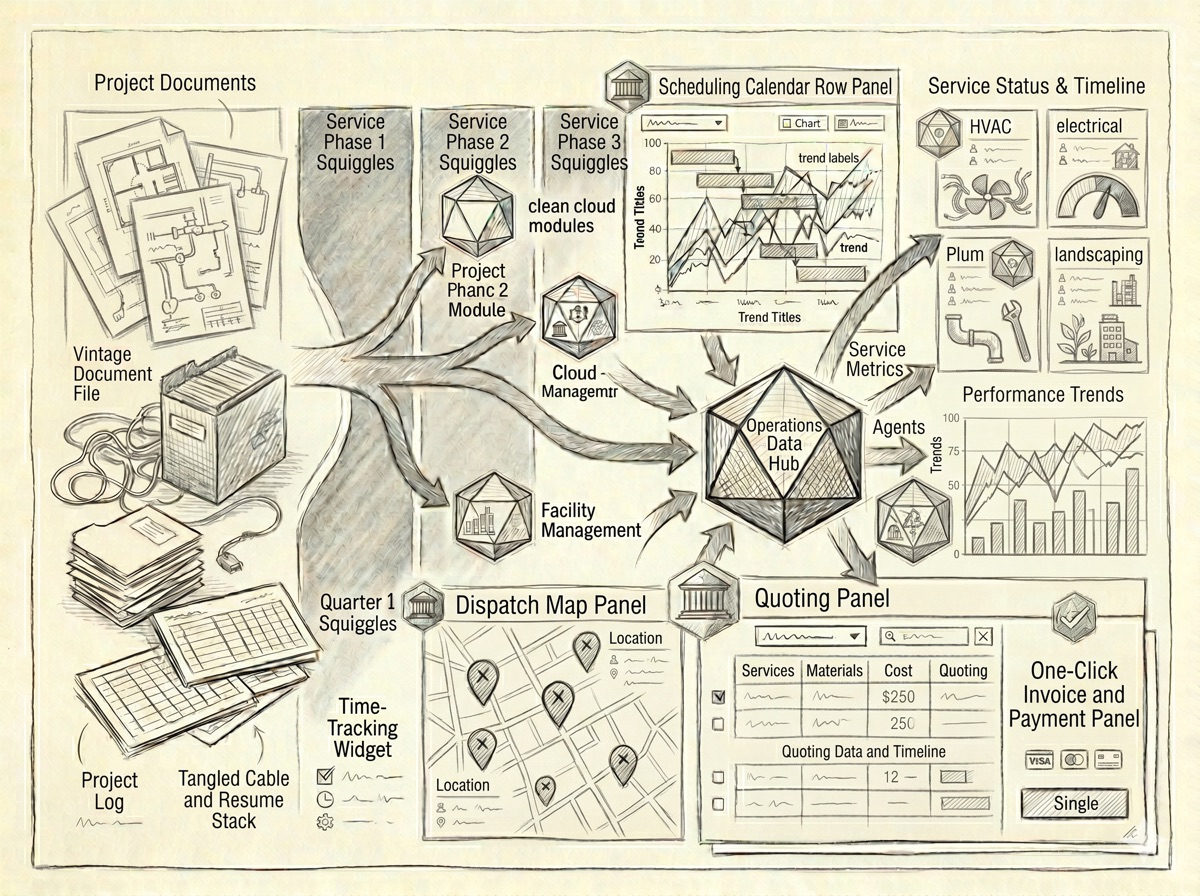
A holding company deployed ServiceFlowAI across four portco brands as a shared operations layer, unified dispatch, quoting, and customer automation under each brand's own logo.
The holding company had acquired four home-services brands (HVAC, electrical, plumbing, landscaping) and wanted to pull ops leverage without forcing rebranding. Each brand kept its identity, website, and customer relationship, but the owner wanted a shared agentic operations layer for quoting, scheduling, and follow-up. Building four SaaS products was out of the question. Buying four off-the-shelf tools meant four integration projects.
We licensed ServiceFlowAI as a multi-tenant private label. Each of the four brands got its own branded portal, custom domain, and white-labeled customer emails, all running off a single tenant backbone. Quoting automation was tuned per vertical; the dispatch agent was shared. We wired their existing CRM exports into a unified customer view for the holding company, while each brand's frontline team sees only their own accounts. Rebrandable updates roll out once and propagate to all four tenants.
- Deployed across 4 branded tenants in 6 weeks, a single integration, not four.
- 31% faster quote turnaround across all four brands.
- Holdco-level visibility into portfolio ops without disrupting brand identity.
- One engineering relationship instead of four, meaningful TCO reduction for the holdco.
Technology Leadership for Higher-Ed Compliance
Higher education. Title IV federal financial aid
Ongoing engagement
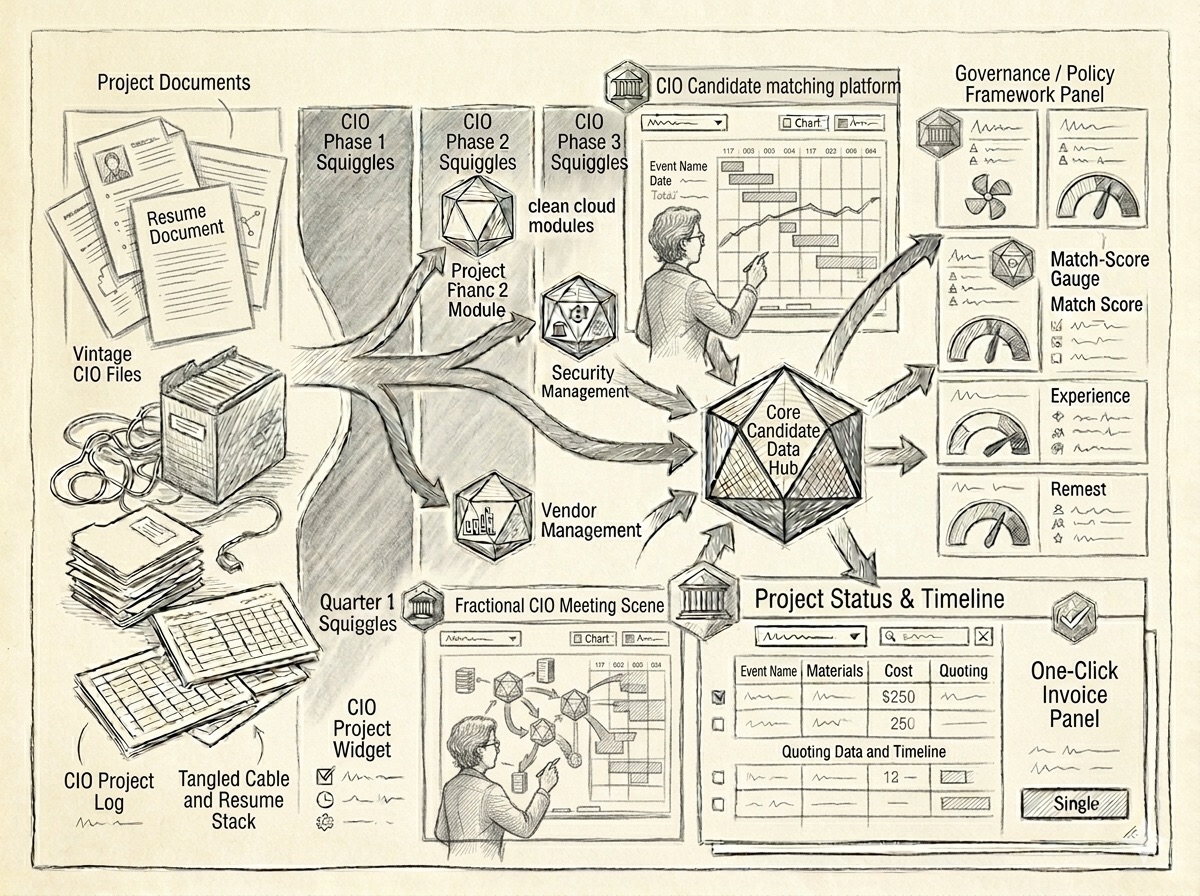
Installed the technology leadership layer that turned scattered compliance tooling into a governed, audit-ready platform supporting a $700M+ federal aid portfolio. Built and rolled out an agentic compliance system that produced $2.7M in new revenue within three weeks of go-live.
The institution had outgrown informal IT. Compliance, financial aid, and operations each owned their own tools. Decisions were getting made without the right context, vendors filled the leadership vacuum, and there was no governance layer accountable to the executive team. Hiring a full-time CIO was years out, but the gap was producing real risk against a $700M+ federal aid portfolio.
We installed the CIO function fractionally. Phase 01 was a full systems and infrastructure audit with an executive debrief and a 12-month roadmap. Phase 02 was the systems blueprint: governance design, written policies, integration architecture across compliance and aid systems, and a vendor evaluation framework the team now uses on every purchase. From the retainer seat in executive meetings, we then led the design and rollout of a production agentic compliance platform from zero, built against the governance standards we'd just installed.
- $2.7M in new revenue within 3 weeks of agentic compliance platform rollout.
- Governance and vendor framework now used on every technology purchase across the institution.
- Full audit trail at every decision point, diligence-ready from day one of the engagement.
- Standing executive participation, quarterly board-level technology readouts, no full-time CIO required.
See what we would ship for you.
Los AngelesMost AI never makes it past the pilot. The systems that reach production all share the same blueprint.

The Build, Deploy, Operate framework.
Our field guide to taking AI from a working demo to a production system your team actually runs, the exact sequence, the failure points, and how we close them.